 HERMES / BOOKSHELF
Liz Greene’s Saturn: The Face Behind the Beast
Could silence and constant talk conceal the same fear? A reading of Liz Greene’s Saturn through security, self-worth, creativity and relationships.
In this article
At one point in Saturn, Liz Greene places a quiet person and an incessant talker on the same page. One struggles to speak; the other says a great deal while rarely approaching what matters most personally. In Greene’s interpretation, these apparently opposite behaviours may share a fear: revealing oneself. (Saturn, 2011, pp. 58–59.)
For a reader accustomed to matching a planet with a single behaviour, this is a reason to pause. Silence and talkativeness are different things. Yet seeing what someone does does not always tell us why they do it. Greene’s thinking about Saturn works in that space between behaviour and motive.
First published in 1976, Saturn: A New Look at an Old Devil invites a reading of Saturn that reaches beyond restriction, deprivation and responsibility. Its concern is how people defend themselves where they feel vulnerable, and what need those defences are trying to protect. Urania Trust · 1976 publication
Entering Saturn through a fairy tale
Greene opens the book with a story rather than an event in the sky. She recalls Beauty and the Beast. When the frightening Beast becomes a Prince, we accept the transformation within the tale. Two seemingly incompatible faces can belong to the same being.
She then brings that possibility into her reading of Saturn. When we label a symbol entirely bad, might we lose half its meaning? This is the question she opens in the introduction. Alongside the Saturn associated with fear, frustration and limits, she explores another possibility: reconsidering our relationship with ourselves. (Introduction, pp. 9–14.)
Jungian thought, mythology, alchemy and esoteric teachings inform this approach. The introductory image of lead becoming gold matters for that reason. In Greene’s analogy, the alchemist is also involved in the work being done on the material. Understanding Saturn becomes a more personal, demanding undertaking than assembling a list of traits.
The change the book proposes involves more than finding comforting language for hardship. Greene distinguishes values acquired from other people from those developed through experience. In the chapters that follow, looking successful, feeling secure and valuing oneself repeatedly turn out to have a complicated relationship.
One difficulty, four areas of life
The first four chapters approach Saturn through water, earth, air and fire. Greene discusses signs and houses together; houses are sections of an astrological chart associated with areas of life such as family, livelihood, communication and creativity. This organisation makes it easier to follow an abstract argument into everyday examples.
Water: having a home and feeling at home. In her discussion of the fourth house, Greene compares the emotional atmosphere of childhood to an underground river beneath the personality. Habits and ways of seeking protection may continue below what is immediately visible. She then turns to a concrete example: an emotional need for security expressed through acquiring a house or land. The solidity of a building and a sense of inner security are different things. That distinction changes the discussion. Greene moves from asking what someone owns to asking what they feel. (pp. 19–22.)
Earth: why can’t you enjoy what you have earned? In the second-house section, Greene describes someone who has acquired material resources through their own efforts but remains too afraid of losing them to enjoy them. Money in the bank, a house and a car have not entirely provided the security being sought. Her interest moves from the amount of money to the person’s understanding of value. If possessions are the only measure of worth, how much will ever be enough? The chapter explores how external accumulation can become entangled with the search for value within. (pp. 36–40.)
Air: the number of words and the depth of a conversation. Here we return to the quiet person and the talker from the opening. In Greene’s third-house discussion, one may conceal a thought for fear of humiliation. The other may keep the conversation going without reaching what matters personally. Her interest is in what can be shared. This is one of the clearest examples of her interpretive method: opposite outward behaviours may conceal a similar attempt at self-protection. (pp. 56–60.)
Fire: recognising yourself in what you make. The fifth-house section considers creativity beyond the production of an object. Greene is also interested in recognising oneself through expression. Work has been made; effort has gone into it; perhaps it has received praise. Yet its maker may struggle to feel its personal value. The discussion opens onto a quieter question than visible achievement: can someone form a relationship with what they have made without waiting for another person’s approval? (pp. 79–83.)
Across these chapters, Saturn’s concerns change their setting. Security, value, speech and self-expression each receive attention. The movement to follow in Greene’s writing is from the outward event to what it means to the individual. These are her symbolic interpretations; a placement does not establish the same life story for everyone.
Becoming your own audience
The fifth-house discussion contains a particularly vivid tension. Someone who wants to express themselves may also monitor that expression constantly. Greene distinguishes a blocked creative flow from a blocked opportunity to recognise oneself through the work. A person may continue producing while feeling increasingly disconnected from what they produce.
Consider a small thought experiment. You sit down to draw something you enjoy. As you make the first mark, before there is much of a picture to look at, an imagined audience has already taken its seat. You begin judging whether the result will be good enough before discovering what it might become. Your hand follows the line while part of your attention follows the people who might judge it.
This scene is our example, not a case history from the book. It offers a way to think about the self-monitoring and need for recognition Greene discusses in the fifth house. The question it leaves is simple: are you looking at what you are making, or at what it might say about you?
Here the book reaches a point where advice to work harder would be insufficient on its own. Effort and discipline retain their value, but the motive behind the work deserves attention too. Curiosity? The pleasure of trying something? A need for approval? Allowing several motives to coexist is part of the space this reading can open.
The shadow that appears between two people
After the elemental chapters come aspects in the birth chart, followed by synastry. Aspects describe relationships between planets in a chart; synastry considers two people’s charts together. Saturn is then read in contact with other functions, rather than in isolation.
In the Sun–Saturn section, Greene explores the relationship between proving oneself and feeling one’s worth. Reaching a goal may be insufficient; the identity and confidence developed through working towards it also matter. The question of value raised in the second-house material returns in another form. (pp. 94–97.)
At the start of the synastry chapter, she argues that simply calling a connection restrictive or karmic offers the people involved little help. She wants to investigate what feels hurt, what is being defended and what is being placed onto the other person. Projection, as she uses the term, concerns experiencing in someone else qualities one finds difficult to recognise within oneself. (pp. 147–151.)
Her discussion of Venus–Saturn makes this more concrete. In the situation she describes, a person may admire a partner’s ease and capacity for affection while feeling inadequate beside those very qualities. Admiration can mingle with envy, possessiveness or a search for emotional guarantees. Greene asks what need lies beneath the visible demand being made within the relationship. (pp. 162–165.)
The value of these passages can be sought in the attention they bring to what remains unspoken between people. Understanding the fear behind a behaviour, however, does not require accepting the harm it causes. That distinction matters when thinking about intimacy and responsibility.
Appreciating the book while questioning it
Robert Hand, who wrote the foreword to the 2011 edition, raises a significant objection while discussing Greene’s contribution: he disagrees with equating signs and their corresponding houses. He considers them different symbolic systems with different functions. Reading Taurus and the second house together here should therefore not be taken as a technical rule shared by every astrological approach. Hand’s willingness to make this criticism in an appreciative foreword offers a useful example of how to read the book. (Foreword, p. 6.)
Some of Greene’s generalisations about family and gender roles also carry the assumptions of their period. Readers can question those assumptions. At times, the relationship she proposes between inner life and outer circumstances also becomes a very broad explanation. Accounting for financial hardship, loss or another person’s behaviour solely through an individual’s inner life can leave observable circumstances out.
The book is strongest in its detailed attention to the needs that may underlie behaviour. Recognising oneself in an explanation does not, by itself, establish that it accounts for the entire situation. Interest and questioning can accompany each other throughout a reading. Treating Greene’s Jungian, astrological and esoteric ideas within their own frameworks makes a more attentive reading possible.
Which edition, and how should you approach it?
Opening Saturn only to find a particular placement can obscure some of its connections. The fairy-tale and alchemical images introduced at the beginning, the questions about value and defence, and the concern with wholeness connect the elemental chapters to aspects and relationships. Reading the introduction, then spending time with one section and comparing the questions it opens and closes with, can help you follow the argument.
Author: Liz Greene. Original title: Saturn: A New Look at an Old Devil. First publication: 1976. The direct book readings for this article used the 2011 English edition, with Robert Hand’s foreword. Its ISBN is 9781578635078. Page references in this article refer to the printed pages of that edition.
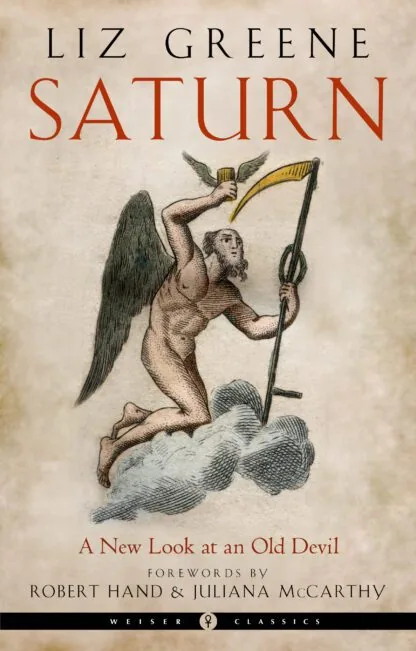
The cover pictured here belongs to the 2021 Weiser Classics edition: 288 pages, forewords by Robert Hand and Juliana McCarthy, ISBN 9781578637355. Check the language and ISBN when choosing a copy. 2021 publisher’s record
For the author’s life, education and other work, read our Liz Greene biography.
Looking at the Beast again
At the end, Greene writes that a symbol cannot be exhausted through words alone. The idea that a person cannot be entirely captured by the signs of a horoscope accompanies her conclusion. The opening tale acquires another meaning as the book closes. (Conclusion, pp. 193–196.)
Seeing only what frightens us in the Beast would prevent us from understanding the tale’s transformation. Ignoring the Beast in our wish to see the Prince would leave something out too. The attraction of Greene’s approach to Saturn lies in her attempt to hold both faces in view.
Return once more to the quiet person and the talker. We are doing more than counting words now. We are curious about what cannot be said. One of the best habits the book may leave with a reader begins there: remembering that naming a behaviour may only be the beginning of understanding it.
What reviewers and readers say
Two published reviews offer different perspectives on the book. The general Goodreads page is also linked for further reader responses.
Cafe Astrology · book review
The review highlights Greene’s psychological approach and her treatment of natal charts and synastry. It recommends the book to readers interested in exploring the reasons behind human behaviour. Read the review.
Kalagni · Spiral Nature · 29 May 2012
Kalagni values the book’s move away from fixed destiny. The review also asks for more differentiation between aspect types and finds some of the language dated. Read the review.
Goodreads · readers’ book page
For further reader responses and edition listings, visit the book’s Goodreads page. Open the Goodreads book page
Sources and reading note: This essay draws on close reading of our copy of the 2011 English edition’s foreword and introduction, with relevant pages from the elemental, aspect, synastry and conclusion chapters. It is not an exhaustive summary of the book. Page references identify the printed 2011 edition. The 2021 edition details were checked against the publisher’s record. The drawing scene is a Hermes thought experiment; the review selections summarise their linked sources. Sources examined on 18 October 2026.
Frequently asked questions
What is Liz Greene’s Saturn book about?
It looks beyond Saturn as restriction and deprivation, exploring how people defend themselves where they feel vulnerable and what need those defences protect. Greene draws on Beauty and the Beast, Jungian thought, mythology and alchemical imagery.
Which editions of Liz Greene’s Saturn are available?
The book was first published in 1976. This review used the 2011 English edition with Robert Hand’s foreword, ISBN 9781578635078. The 2021 Weiser Classics edition has 288 pages and forewords by Robert Hand and Juliana McCarthy.
What criticisms have been made of Liz Greene’s Saturn?
Robert Hand’s foreword disagrees with equating signs and their corresponding houses. Kalagni’s review asks for more differentiation between aspect types and finds some language dated. The review also notes that some family and gender-role generalisations carry their period’s assumptions.